
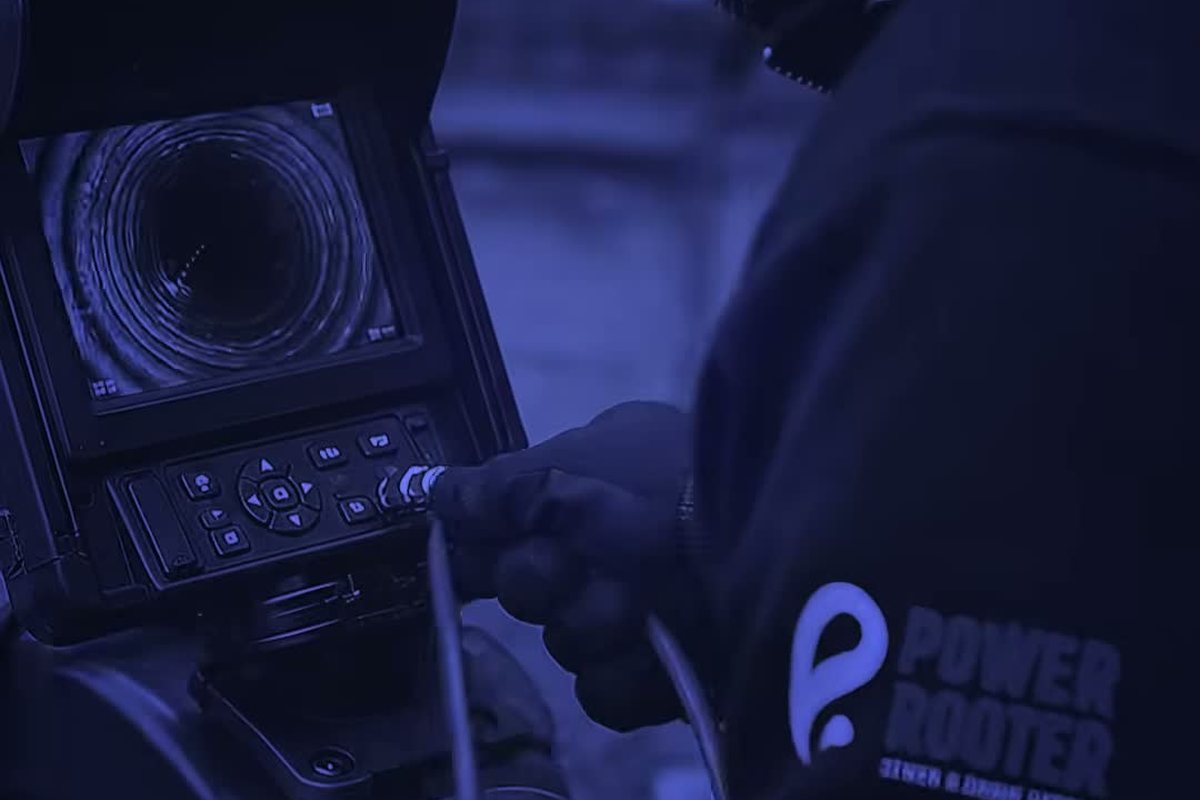
Orangeburg pipe is a fiber sewer pipe of compressed wood fibers and coal tar pitch, used in many towns in the mid-1900s. As it ages it flattens and loses its round shape. A camera inspection gives clues to whether you have Orangeburg, clay or cast iron.
Orangeburg pipe, also called bituminous fiber pipe, is a sewer pipe that APWA-MN describes as layers of compressed wood fibers soaked in coal tar pitch; one city building office says it also contained asbestos.
One city building office puts its use mostly between the early 1950s and the early 1970s. As it ages, it flattens and loses its round shape. A camera inspection gives the best clues to whether you have it.
Orangeburg, clay or cast iron: how they compare
| Pipe | Made of | When it was common | How it fails |
|---|---|---|---|
| Orangeburg | Wood fibers and coal tar pitch | Early 1950s to early 1970s (Ann Arbor estimate); maker closed 1974 | Flattens and "loses its circular cross section" (City of Ann Arbor) |
| Clay | Fired clay in short sections | Made in the U.S. since about 1849; compression joints came after research in the 1940s and 1950s (NCPI) | "mortar-type joints" that "loosen up" over decades; roots get in (LookSmart) |
| Cast iron | Heavy iron pipe with caulked joints | Demand "increased greatly after World War II"; caulked joints until the late 1950s (CISPI) | "corrodes and flakes apart" (LookSmart) |
In short: clay has been made in the U.S. since about 1849, cast iron demand grew greatly after World War II, and in Ann Arbor, Michigan, Orangeburg was used mostly from the early 1950s to the early 1970s.
These eras tell you what was common, not what a given house has.
John Martino, a New Jersey home inspector not tied to Power Rooter, sums it up: "Clay is brittle and cracks, cast iron corrodes and flakes apart, and Orangeburg collapses." (LookSmart Home Inspections)
Why it matters in Westfield, Cranford and Brooklyn
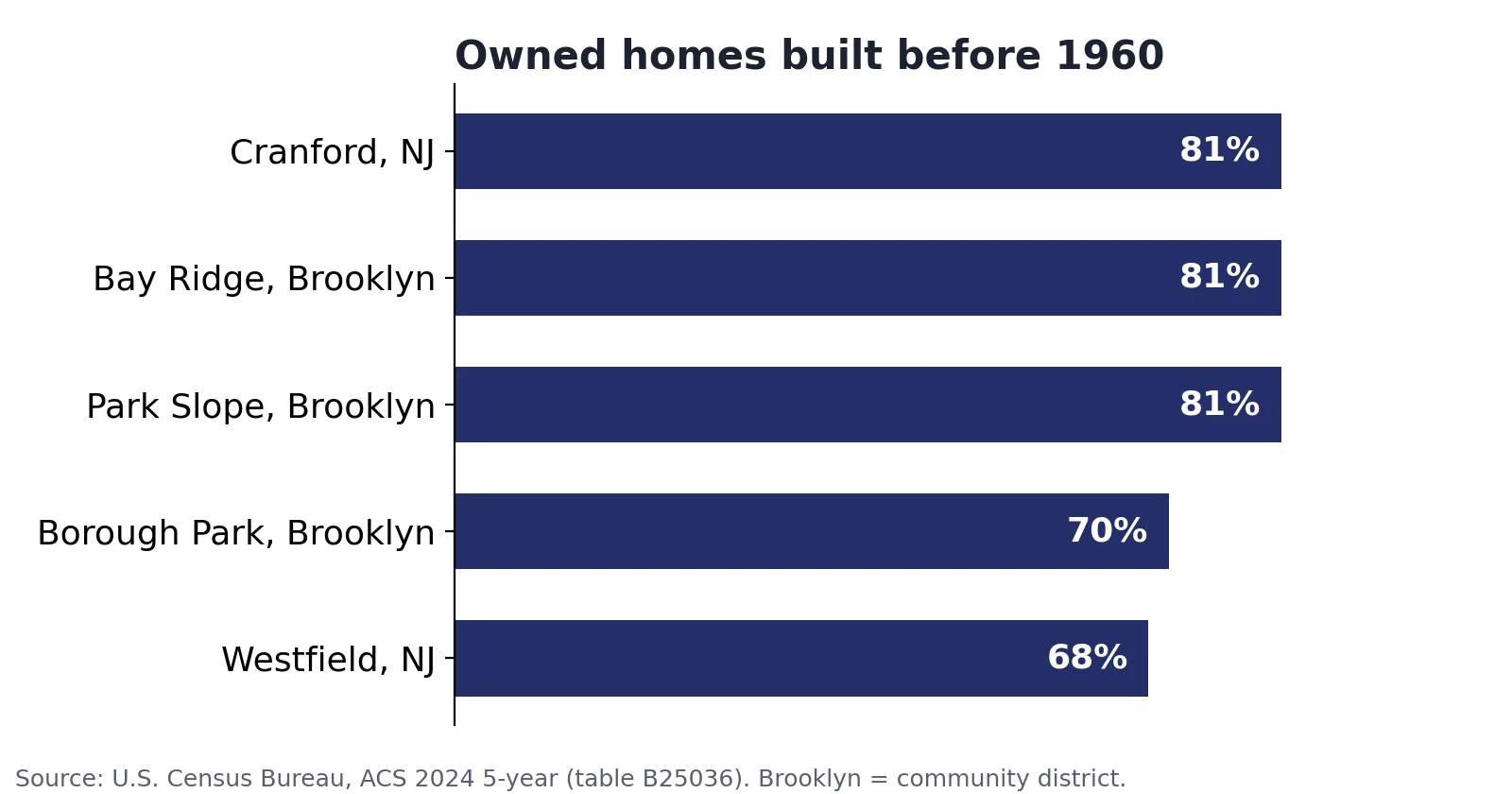
Census figures (ACS 2024): 81% of owned homes in Cranford, Bay Ridge and Park Slope, 70% in Borough Park and 68% in Westfield were built before 1960.
House age does not tell you the pipe. A house may still have its first sewer line, or one replaced long ago. It does tell you to check.
What is Orangeburg pipe?
APWA-MN says the pipe was first made by the Fiber Conduit Company of Orangeburg, New York, which changed its name to Orangeburg Manufacturing Company in 1948.
"Orangeburg" is the brand name of a pipe made by the Orangeburg Manufacturing Co. of Orangeburg, New York (City of Ann Arbor).
The American Public Works Association's Minnesota chapter says it "is made up of layers of compressed ground-up wood fibers that are impregnated with liquefied coal tar pitch," and that the company "closed for good in 1974" (APWA-MN).
- Advertised life: its useful life "was previously thought and advertised to be 50 years" (APWA-MN).
- Failures: Ann Arbor's building office says these pipes "have experienced numerous failures over the years, and many systems have needed complete piping replacement" (City of Ann Arbor).
- Tree roots: "as the black tar pitch dries moisture from sewer flows penetrates the pipe walls, roots find their way in" (APWA-MN).
- Solvents: paint thinner or adhesive cleaner down the drain "will cause deterioration" (City of Ann Arbor).
How to find out what you have
- Know that the pipe you can see where it leaves the house may not match the pipe under the yard.
- In Ann Arbor's experience, fiber pipe "probably" ran from about 5 feet outside the foundation to the street, with other material under the basement slab.
- Get a camera inspection. Ann Arbor notes a video scan "may yield clues sufficient to identify the type of pipe".
Is it safe to clean an old line?
Look first, then decide whether to clean an Orangeburg sewer line or replace it, by digging or trenchless pipe bursting (in NYC, ask what the code allows).
Ann Arbor warns that snaking with a cutting tool "may cause damage" to fiber pipe. Power Rooter's camera decides whether a line is safe to jet, and for an old, badly worn section it recommends another approach.
See what is under your house
Power Rooter's camera inspection records the line in HD and notes where problems are, how deep the line sits and any damage.
Book a sewer camera inspection in Westfield ((908) 666-8686), a sewer camera inspection in Bay Ridge or a sewer scope inspection in Park Slope ((718) 686-8686).
Common questions
Is Orangeburg pipe asbestos?
Sources differ. Ann Arbor's building office says it was made from plant fibers and asbestos soaked in a tar-like substance. APWA-MN describes compressed wood fibers and coal tar pitch.
Is Orangeburg pipe still made today?
The Orangeburg Manufacturing Company closed in 1974, according to APWA-MN.
Should I buy a house with Orangeburg pipe?
You can. Get the line scoped before closing, take the footage to the seller, and ask for a credit or a repair.
KEEP READING
More from Power Rooter
Sewer Backup in a Brooklyn Basement: What to Do First, Backwater Valves and Insurance
If sewage backs up into your Brooklyn basement, stay out of the water, report it to 311 and take photos. On 75% of Brooklyn backup calls in the past year, DEP found no city sewer problem (counts calls, not pipe condition).
Who Is Responsible for the Sewer Line From the House to the Street? Westfield, Cranford and NYC
In New York City, the property owner owns the whole sewer line to the city main in the street. Westfield's Public Works repairs broken sewer mains, and Cranford checks each backup to decide whose it is. Here is what each place says.
Belly in a Sewer Line: How Serious Is It, and Does It Need Fixing?
A belly is a sag in a sewer line where water and waste collect. Home inspectors report over 1 inch of standing water as a flag to look closer. A minor sag may not affect the line; one that keeps clogging needs a repair quote.
Dealing with this right now? We run same-day trucks across NYC and northern NJ.
Call (718) 686-8686